Let's talk
Web directory Dog care India Live and expanding 2026 View live ↗

CaninePages

Everything a dog owner has to go looking for, from the first adoption to the midnight emergency, across six Indian cities and counting.

Info Project Overview

Challenge

Owning a dog in an Indian city is a running list of things to find: a vet, a groomer who is gentle with an anxious dog, boarding for the week you are away, a trainer, somewhere that genuinely welcomes dogs, and at some point an emergency clinic at an hour when nothing else is open. First-time adopters have it hardest, because they do not yet know which questions to ask. The usual answer is Maps, a star average built from a handful of reviews, and a number that may not have been checked in two years. Directories make it worse by filling every field: a blank speciality becomes a guess, a stale phone number reads exactly like a current one, and nothing on the page says how old any of it is. The cost of being wrong is highest at the moment there is least time to check.

Solution

CaninePages is live with 1,607 dog-relevant listings across Mumbai, Pune, Delhi, Bengaluru, Hyderabad and Chandigarh, sorted into what people actually go looking for: vets, emergency care, blood banks, grooming and spa, trainers and behaviour, boarding and daycare, walkers and sitters, dog-friendly places, stores and pharmacies, and rescue and adoption. Beside them sit practical guides for the questions a listing cannot answer, like travelling with a dog in India or what to check before choosing boarding. The directory treats the limits of its own data as content: every listing is dated, unconfirmed ones say so on the category page, and a field it does not have reads “Not available” rather than being filled in. Ratings show the number of one- and two-star reviews next to the average. Emergency care has its own page and its own link in the header, neighbourhood is the primary filter, and the whole thing installs as an app that works offline with saved listings kept on the device. More cities and deeper data are being added city by city, which is exactly why the confidence markers had to come first rather than get bolted on later.

Where it is now

Six cities are live and the next ones are in progress, so the honest answer is that this is still being built. Even so, it already does the job. Someone adopting their first dog can read a guide, then find a trainer, a groomer and a vet in their own neighbourhood, and see how fresh each listing is. Someone whose dog is unwell at midnight can reach emergency care from any page on the site. Every new city arrives under the same rules, so growing the data does not quietly make the older entries harder to trust.
A directory is only worth what it admits it does not know.
How I built it

Every screen shows its own confidence.

I built this the way I would want to read it at eleven at night with a sick dog, and the way a first-time adopter would want to read it on a calm Sunday: say what is known, date it, mark what is missing, and put the emergency route one tap from wherever you are. It is still growing city by city, so those rules had to hold from the very first listing.

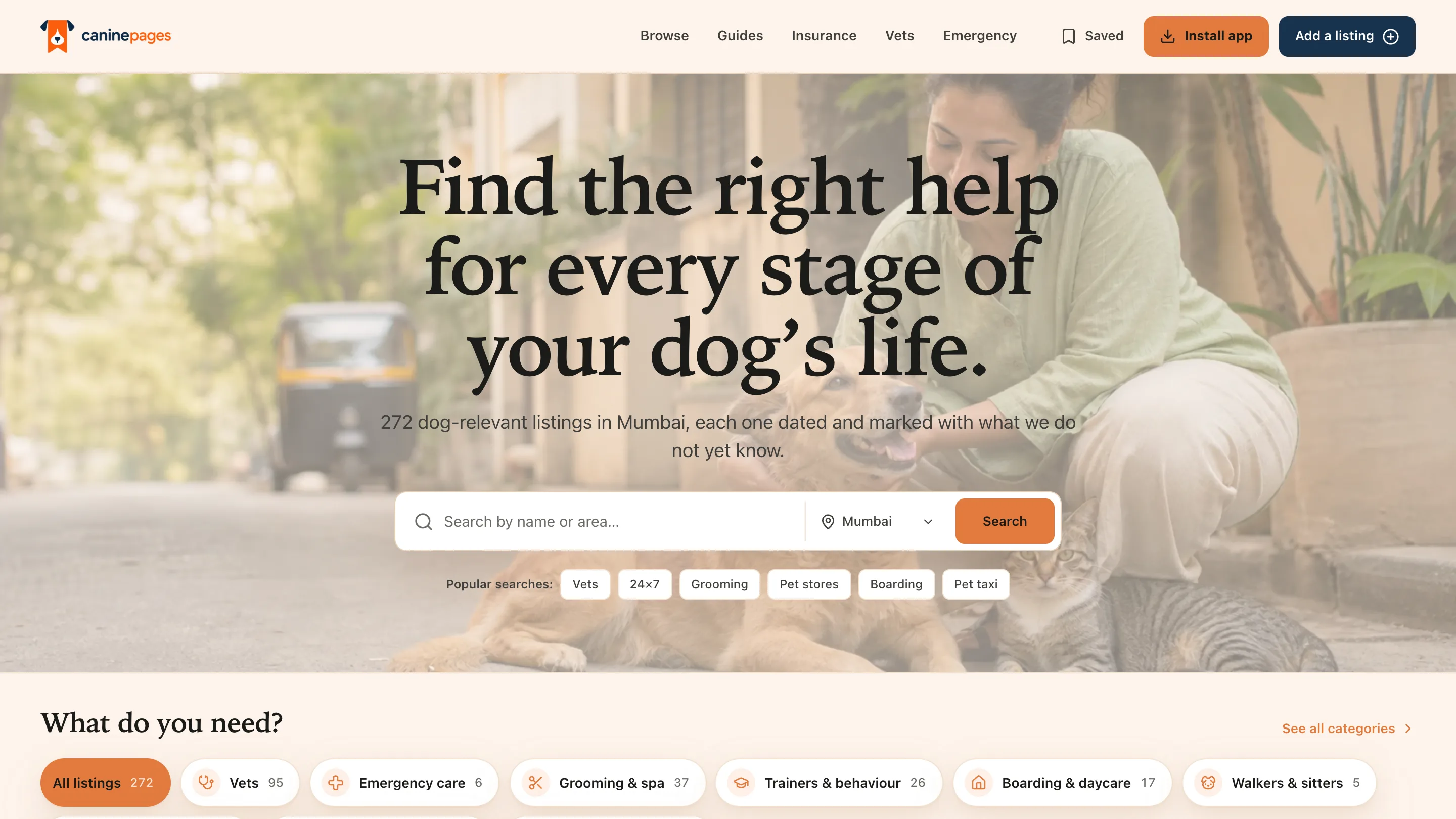
CaninePages home page with a city search for Mumbai, a headline reading "Find the right help for every stage of your dog’s life", and a row of category chips showing counts for vets, emergency care, grooming, trainers, boarding, walkers, dog-friendly places, stores and rescue
What it does

An honest number, not a big one

The home page says “272 dog-relevant listings in Mumbai, each one dated and marked with what we do not yet know.” You get the number and the limit in the same line. Nine categories sit under it, from vets to walkers to rescue and adoption, each carrying its real count, including Dog-friendly places at three. Those counts climb as more data comes in; the caveat next to them does not go away.

The thought process
  • Mark what the directory does not know

    A blank field quietly filled in is worse than an empty one, because it reads identically to a verified fact. Missing data renders as "Not available" and unconfirmed listings say so, which costs the page a little polish and buys back the ability to trust the rest of it.

  • Make it installable, and keep saved listings on the device

    The moment someone needs this most is the moment their connection is least reliable: in a rickshaw, in a basement clinic, at night. It installs as an app, works offline, and the shortlist someone builds stays on their own phone rather than requiring an account to exist.

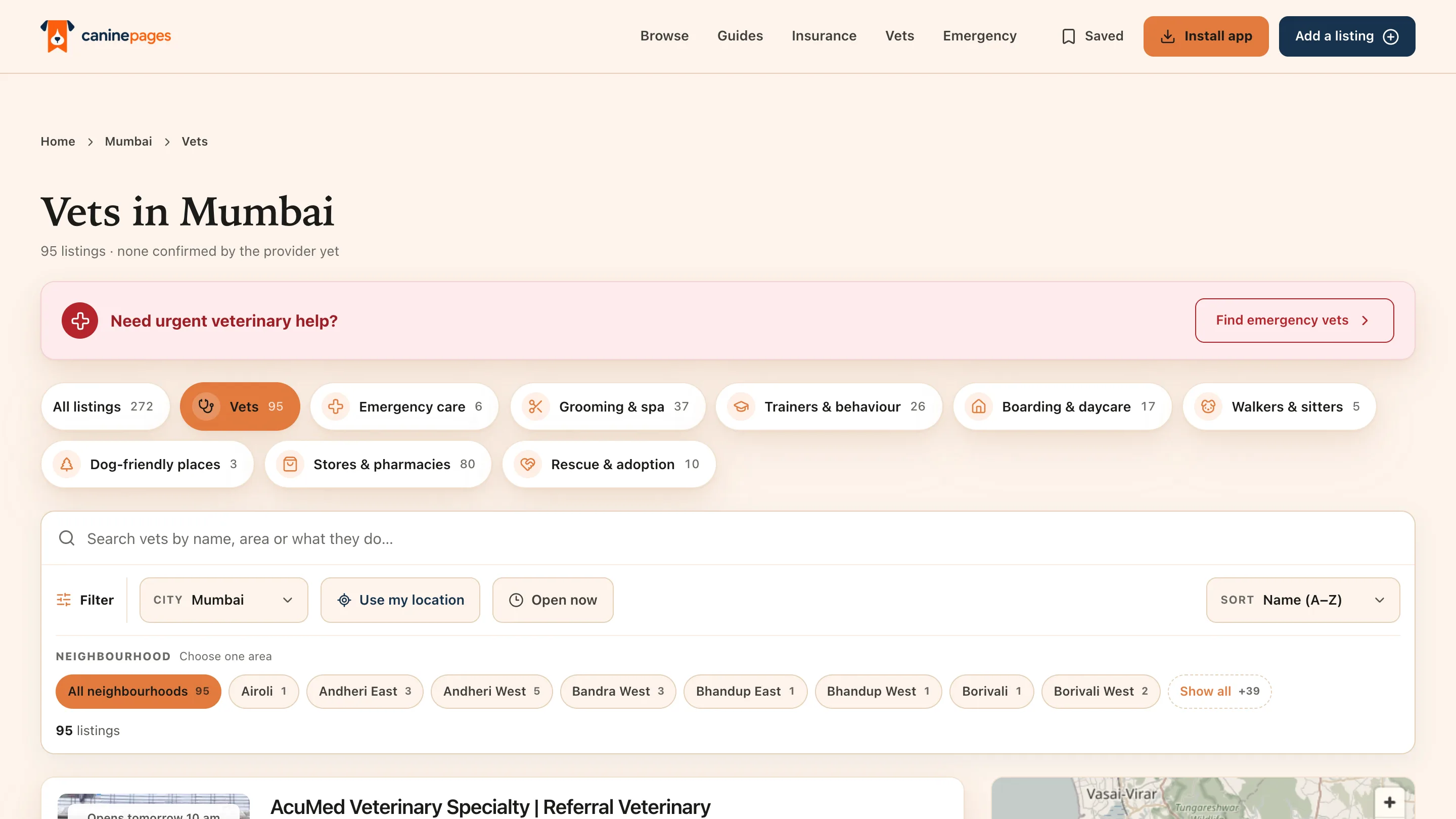
CaninePages category page listing 95 vets in Mumbai, with a subheading reading "none confirmed by the provider yet", an urgent-help banner, category chips, and neighbourhood filters for Airoli, Andheri East, Andheri West, Bandra West and others
What it does

If it is not confirmed, it says so

Where a directory normally puts a claim, this one says “95 listings · none confirmed by the provider yet”. Neighbourhood chips come next, each carrying its own count, because a listing on the other side of Mumbai is not really a result.

The thought process
  • Date every listing, and name what has not been confirmed

    Directory data rots silently, and a two-year-old phone number looks exactly like a current one. Each listing carries its date, and category pages state plainly how many entries the provider has confirmed, so age is a visible property rather than something you find out by calling.

  • Make the neighbourhood the filter that matters

    In an Indian city, distance is measured in traffic rather than kilometres. A highly rated groomer an hour away is not really an option, and on a bad night a vet an hour away is worse. Neighbourhood chips come before sort order and carry their own counts, so the filter that actually narrows the choice is the one in reach.

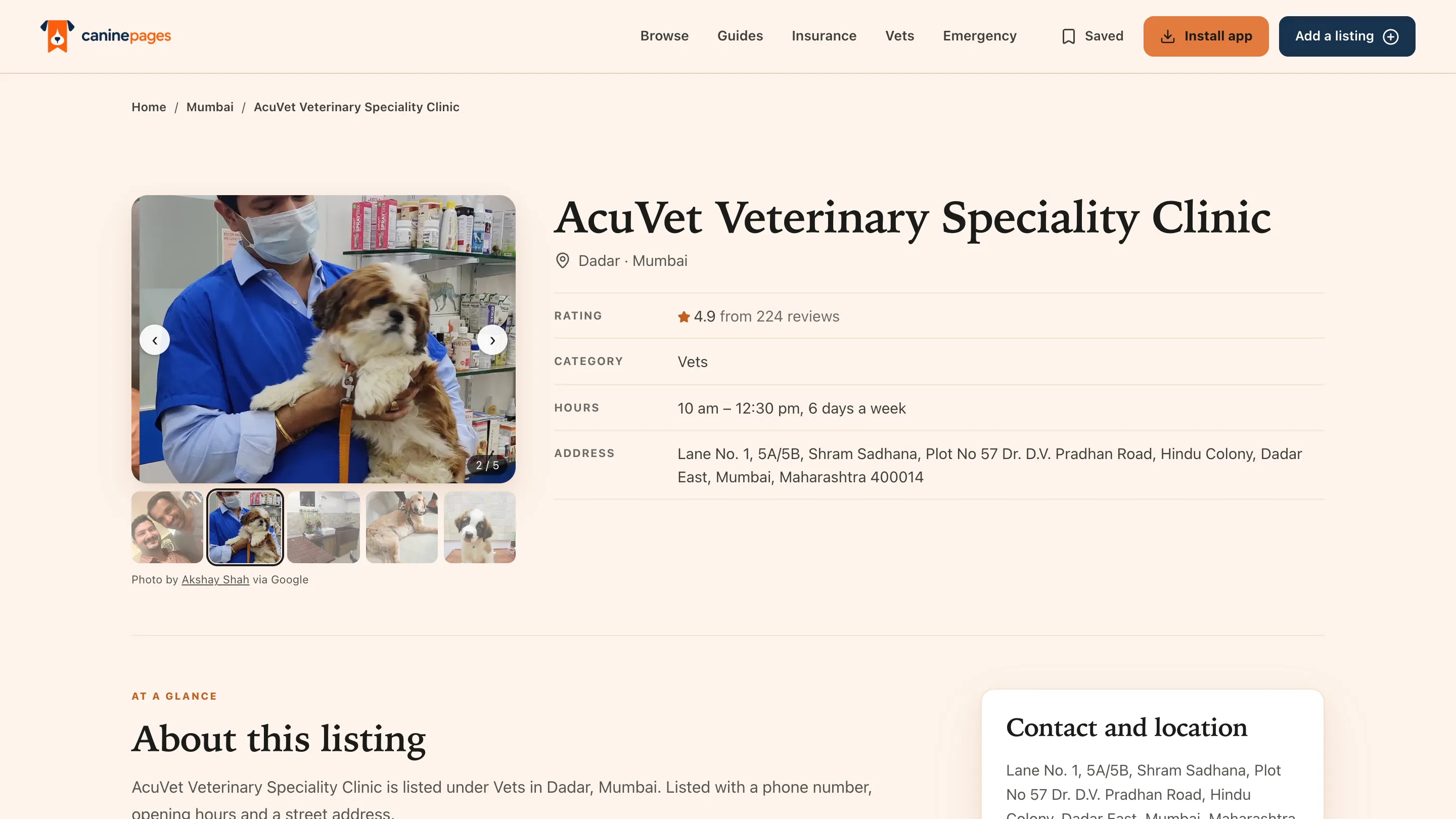
CaninePages listing page for AcuVet Veterinary Speciality Clinic in Dadar, Mumbai, showing a photo gallery credited to a Google contributor, rating, category, hours, full address, and a contact and location card with a call button
What it does

One page, no trip back to Maps

Rating, category, hours and the full street address sit in one block, with call and directions beside them. The gallery credits the photographer by name, so it is clear which parts of the page came from somewhere else.

The thought process
  • Put the hours, the address and the number on the profile itself

    The usual pattern sends people back to Maps to find out whether a place is open, which is where the search restarts and often ends. Rating, category, hours and the full address sit in one block with call and directions beside them, so the profile is the last page needed.

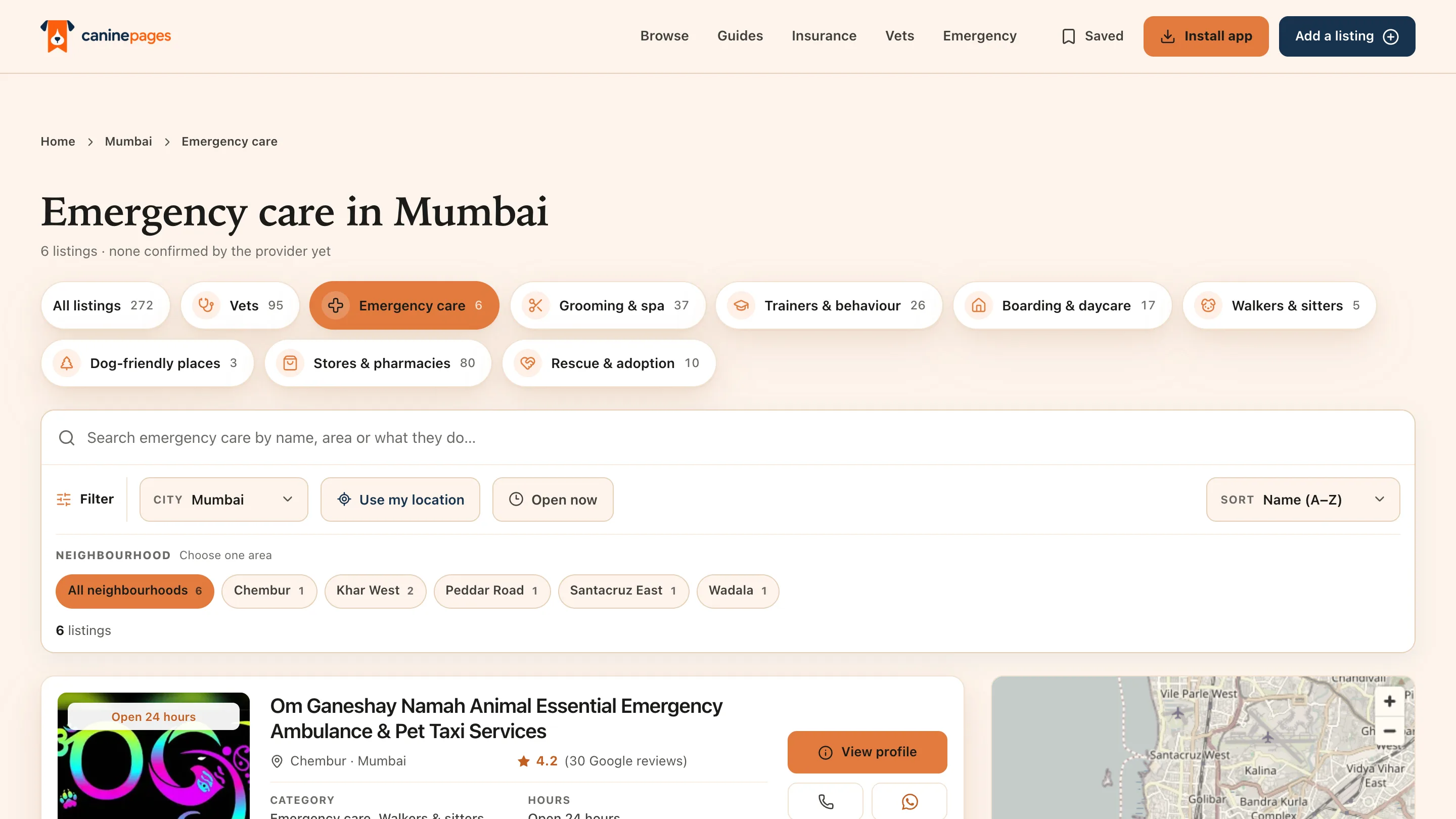
CaninePages emergency care page for Mumbai showing six listings, a 24-hour ambulance and pet taxi service marked Open 24 hours, a "Known for: Not available" field, and a badge reading 6 at 1 to 2 stars
What it does

The bad reviews stay visible

Emergency care has its own page and its own link in the header, so nobody has to go looking for it mid-panic. The card shows 4.2 stars and, next to it, that six of those reviews were one or two stars. Where there is no data, it says “Not available” rather than inventing a speciality.

The thought process
  • Give emergency care its own page and its own link

    An emergency is not a browsing session. Rather than making someone filter their way there, emergency care is a header link on every page and a banner on every category, and the listings show which are genuinely open twenty-four hours.

  • Publish the one- and two-star counts, not only the average

    A 4.2 average built on thirty reviews can conceal six people who had a bad experience, and for anyone you hand your dog over to, that tail is the part worth reading. The count of one- and two-star reviews sits next to the average so the shape of the rating is visible, not just its midpoint.

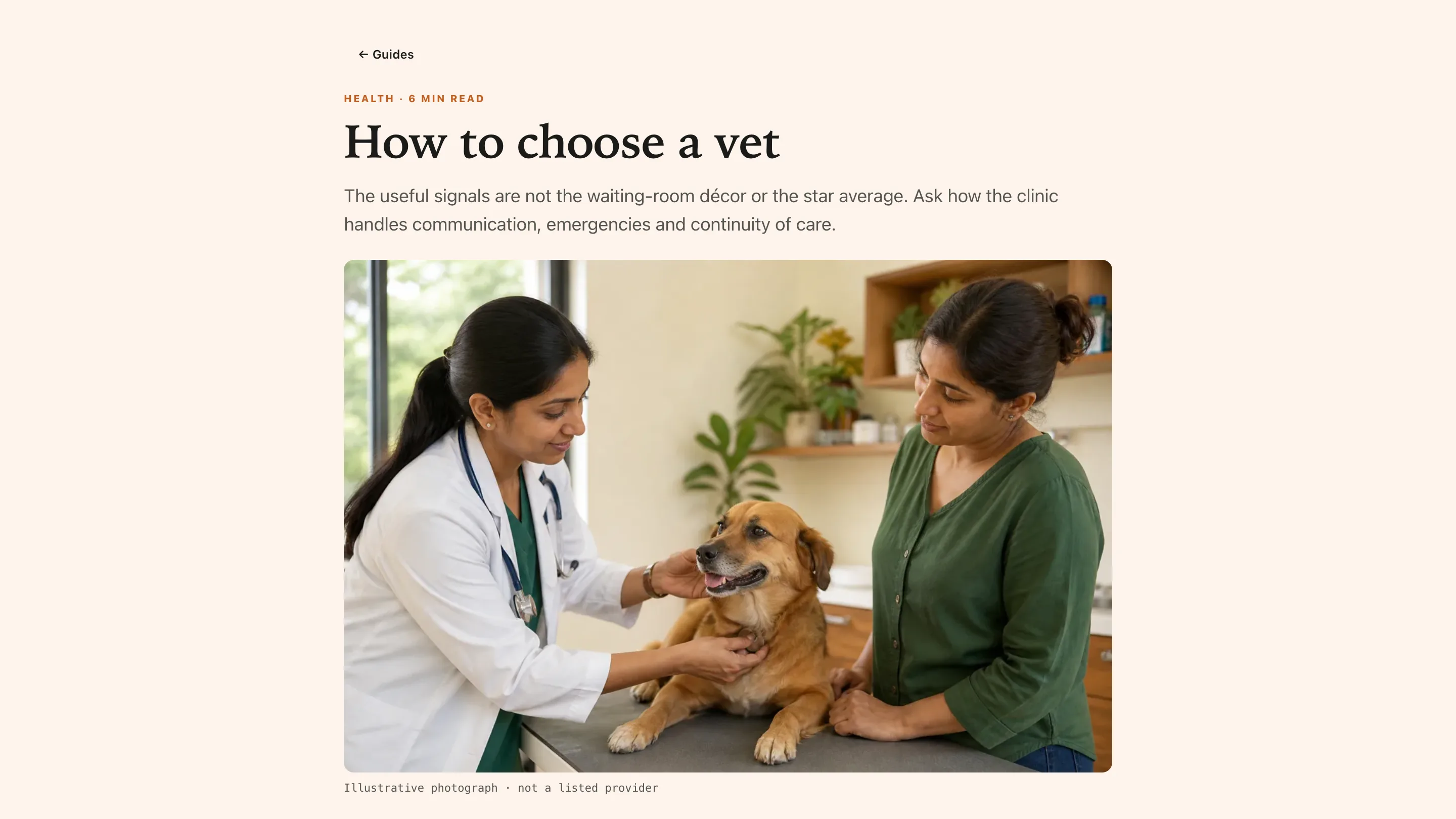
CaninePages guide titled "How to choose a vet" with a six minute read time, a photograph of a vet examining a dog while its owner watches, and a caption reading "Illustrative photograph · not a listed provider"
What it does

Guides that answer, not funnel

The guides cover what a listing cannot: travelling with a dog in India, what to check before choosing boarding, how to tell a genuinely dog-friendly place from one that merely allows dogs. This one argues that waiting-room décor and the star average are the wrong things to judge a vet on, and it stops there, with no listing waiting at the end. Even the photograph is captioned “Illustrative photograph · not a listed provider”, so a stock image never passes for a clinic in the directory.

The thought process
  • Write guides that answer, and label every photograph

    A guide that exists to funnel people into listings is an advert with a reading time. These argue a position, that décor and star averages are the wrong signals for choosing a vet, and every illustrative image is captioned as not being a listed provider, so nothing on the page is mistaken for evidence.

A directory you can tell how far to trust.

CaninePages keeps 1,607 dog-care listings across six Indian cities today, from vets and emergency care to grooming, boarding, walkers and adoption, dates every one of them, and marks the gaps instead of filling them. More cities and more depth are on the way, and each one arrives under the same rules, so the entries it does stand behind keep meaning something.

View CaninePages ↗
FuelNote home screen for quickly logging a meal Next project FuelNote See project