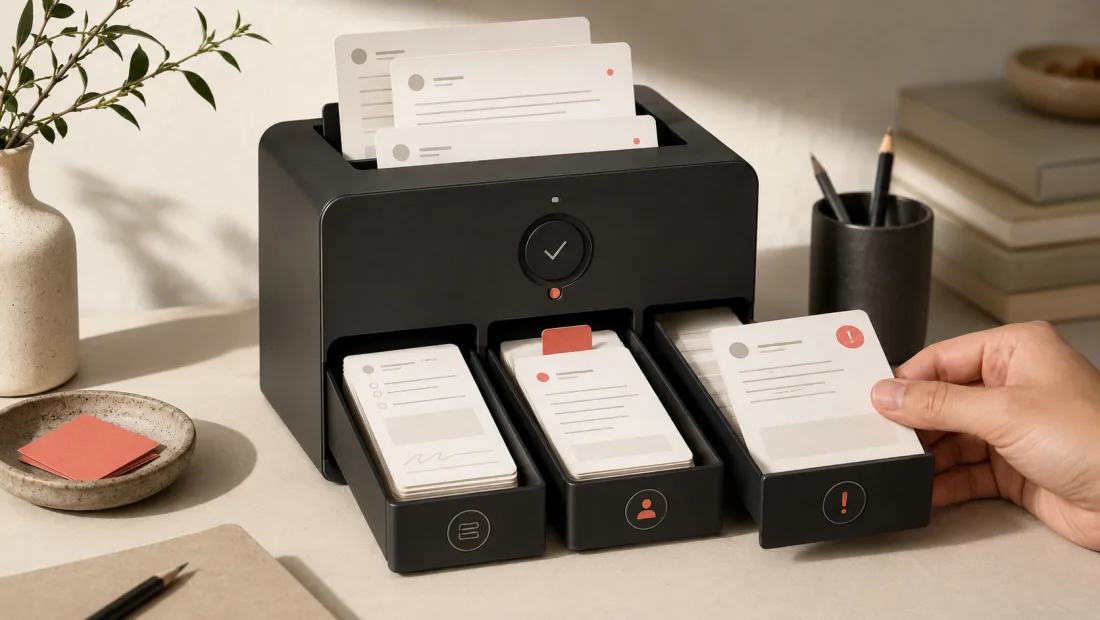
Triage is not replying
Triage is deciding what a message is. A lead. A complaint. A question you have answered two hundred times. Something urgent. Something that can wait until Thursday.
Replying is producing the words that go back to a human being.
Triage is low risk and high value. Nothing goes to the customer. If it sorts wrong, you notice and fix it.
Replying is where the risk lives, because it is the part with your name on it.
Almost everyone tries to automate replying first. Start with triage instead. It is the half that is safe, and it is usually where most of the time actually goes. Sorting thirty messages is a genuinely draining job even though each decision takes two seconds.
The three tiers
Sort your incoming messages into three groups and treat each differently.
Tier 1: safe to send automatically
Factual, checkable, and identical every time.
- Opening hours, location, parking
- Order status, if it comes from your real system
- "Have you received my email" acknowledgments
- Booking confirmations and reminders
- Where to find a form, a link, a receipt
The rule: if the correct answer is a fact you could print on a card, automation is fine.
Tier 2: draft, then a human approves
The large middle, and where most small businesses should live permanently.
- Pricing questions
- Availability and timelines
- Explaining how your service works
- Rescheduling
- Mild complaints
AI writes the draft, you glance and press send. Ten seconds instead of four minutes, with no risk of something strange going out under your name.
Most people treat this as a temporary stage on the way to full automation. It is not. It is the destination for anything where being wrong costs you a customer.
Tier 3: never automate
- Complaints about anything serious
- Anything involving money going the wrong way
- Legal, medical, or safety questions
- Cancellations and refunds
- Anyone who is genuinely upset
- Anything about a person on your team
A simple way to think about it is this. If a reply would need your approval when a new junior employee wrote it, it needs your approval when AI writes it. The standard does not change because the writer is software.
What actually goes wrong
Four failures, in the order of how often I see them.
It answers confidently and wrongly. This is the failure mode behind most AI mistakes. Someone asks whether you handle a specific case. The honest answer is no. It produces a plausible yes, because plausible is what it optimizes for. Now you have promised something.
It cannot tell that someone is angry. Sentiment reads as neutral, tone comes back cheerful, and cheerful is the worst possible register for a person who is already annoyed.
It invents policy. Asked about refunds when you never gave it your refund policy, it will produce a reasonable-sounding one. Reasonable-sounding is not yours.
It never escalates. A human notices when a conversation is going wrong. Automation will keep politely replying until the customer gives up or posts about it.
That last one is why escalation rules matter more than reply quality. A system that hands over early is better than one that writes beautifully and never lets go.
A setup that does not embarrass you
If you do one thing, do this: give it a boundary and an exit.
Include this in any customer-facing setup:
> Only answer using the information provided below. If the answer is not there, do not guess. Reply that you are checking and flag it for a human. Never state a price, a date, or a policy that is not in this document.
Then give it the document. Your actual prices, hours, policies, and the ten questions you get most, with your real answers.
Add automatic handover if any of these are true:
- The customer used words like refund, cancel, complaint, lawyer, or unacceptable
- The same person has messaged three times about the same thing
- It has already replied twice without resolving anything
- Anything about money, dates, or promises
And say so plainly. "You are chatting with an assistant. Ask for a person any time and I will pass you over." People are far more forgiving of a bot that admits it is a bot than one they catch pretending.
What you actually gain
Not "24/7 support." That framing sets an expectation you will fail.
What you gain is smaller and more real:
- Nothing sits unread for two days
- Routine questions stop interrupting your actual work
- Every message gets a first response quickly, even if the real answer comes later
- You stop rewriting the same five paragraphs forever
For a business of one to ten people, that is a meaningful change. It is not a revolution, and it should not be sold to you as one.
The line, in one sentence
Automate the reply when the customer wants information. Keep it human when the customer wants to be heard.
Almost every hard case resolves cleanly against that.
Someone asking your opening hours wants information. Someone asking why their order is late might look like an information question, but is usually asking to be heard.
Get that distinction right and you can safely automate a surprising amount. Get it wrong and it will not matter how good the writing was.