First, see what it says now
Do this before changing anything, or you will never know whether it worked.
Open ChatGPT, Perplexity, and Google's AI mode. Ask each one:
- What does [your business name] do?
- Who is [your business name] for?
- Who would you recommend for [the thing you do] in [your city]?
Write down the answers. Note three things: whether you appear, what it says about you, and who appears instead of you.
That third one is the most useful. Whoever shows up in your place is your real competition for the answer, and reading how they describe themselves usually explains why they got picked.
Repeat this monthly with the same wording. Results vary between sessions, so a single run means little, but the direction over a few months is clear.
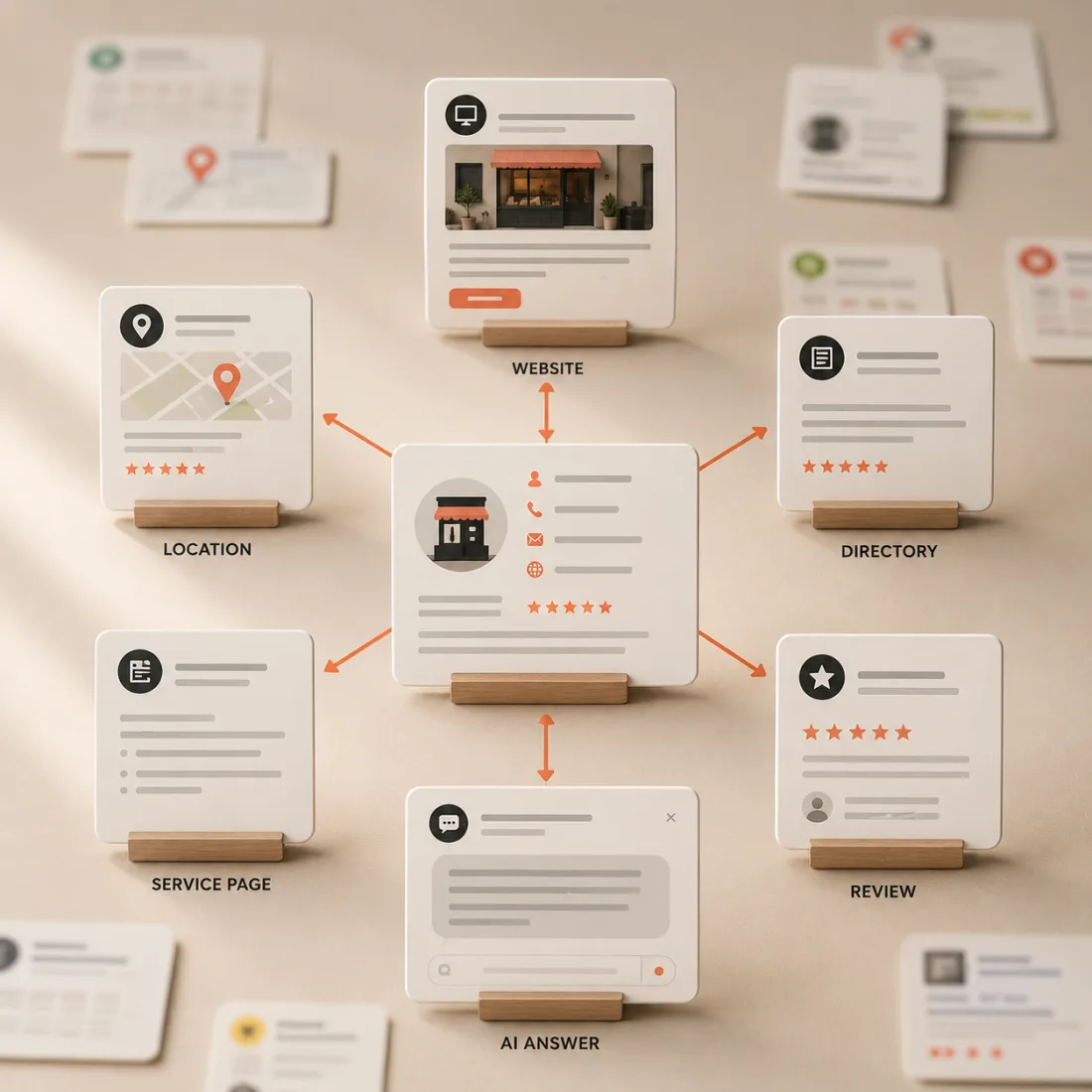
Write one source-of-truth profile
One page. Everything else copies from it.
It needs seven things:
1. Name, written exactly the same way every time. Not "IdeaForge Labs" here and "IdeaforgeLabs" there. 2. What you do, in one plain sentence with no adjectives. 3. Who it is for, specifically. "Small businesses" is not specific. "Independent dental clinics with one or two locations" is. 4. Where you work, whether that is a city, a country, or remote. 5. What you charge, at least a range. This is the field everyone skips and the one buyers ask about most. 6. Proof, with real detail. What you built, for whom, what changed. 7. How to reach you.
Then put that same profile on your about page, your Google profile, your directory listings, your social bios, and anywhere else you exist. Same wording.
A simple way to think about it is this. If five people described you and gave five different descriptions, nobody listening would repeat any of them with confidence. Consistency is not a style preference here. It is what makes a description safe to quote.
Write plain service definitions
Punchy one-liners are for humans who already understand the category. For anything trying to work out whether to recommend you, they say nothing.
For each service, cover five things:
- The problem it solves, in the words a customer would use
- Who it is for, and who it is not for
- What is included, concretely
- What you need from them to start
- What they end up with
That last one matters more than people expect. "A website" is a category. "A five-page site you can update yourself, with online booking connected to your calendar" is something an engine can actually repeat to somebody.
Publish proof that can be quoted
There is a large difference between a claim and a fact.
"We are premium" is a claim. Nothing can verify it and nothing will repeat it.
"We rebuilt a dental clinic's booking page and enquiries stopped arriving with missing information" is a fact. It has a subject, an action, and a result.
Publish the second kind: case studies with real detail, client types, timelines, what the process actually involves, what went wrong and how you handled it. Screenshots where you have permission.
You do not need dramatic results. You need specific ones.
Answer the questions people actually ask
Most sites answer the questions the business wishes buyers asked, and skip the ones they actually ask.
The ones they actually ask:
- How much does this cost?
- How long does it take?
- What do you need from me?
- What happens if it goes wrong?
- Who is this not right for?
Answer those plainly on a public page. Not behind a form, not "contact us for pricing."
The last one is worth doing even though it feels wrong. Saying who you are not for is one of the strongest trust signals available, and it stops you being recommended into conversations you would lose anyway.
Make sure it can be read at all
This is the first thing to rule out when AI recommends someone else instead of you.
Two technical checks, then we are done.
Is your site blocked? Some hosts and security settings block AI crawlers by default. For ChatGPT search, check that OAI-SearchBot is allowed in your robots.txt and through your CDN or firewall. GPTBot is a separate control for potential model training; allowing or blocking it does not determine whether your pages are eligible for ChatGPT search. Other answer engines use their own crawlers and controls.
Is the important text actually text? Words baked into images, or loaded only after heavy scripting, may not be read. If you cannot select it with your cursor, assume it might not be seen.
What to expect
Not overnight results.
AI systems re-crawl and refresh on their own schedule, and changes typically take weeks to show up rather than days. This is why the baseline test comes first. Without it, you will re-ask in a fortnight, get a slightly different answer because these systems vary anyway, and have no idea whether anything improved.
Also worth saying plainly: there is no submission form. No console, no placement program, nobody to pay for inclusion. Anyone selling you a shortcut into ChatGPT is selling air.
The whole job is being the easiest business in your category to describe accurately.
Which, conveniently, also makes your website better for the humans who read it.