First, understand what you are competing for
This is the part that changes how you write everything else.
In traditional search, the unit of competition is the page. Your page ranks or it does not.
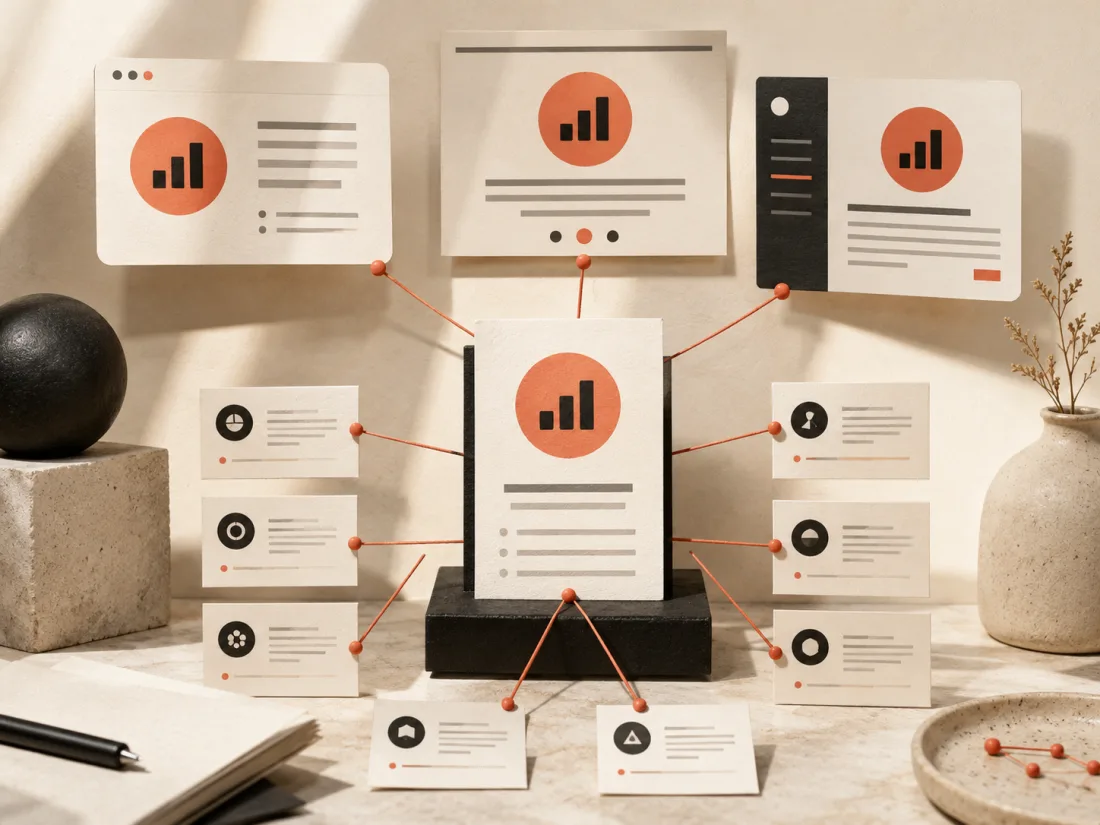
In an AI answer, the unit is the paragraph. The tool is not scoring your whole site. It is pulling specific passages, checking whether they answer the question directly, and stitching two or three sources into something readable.
Which means a brilliant page whose key fact is buried in the eleventh paragraph loses to a mediocre page that answers in its first two sentences.
A simple way to think about it is this. You are not applying for a ranking. You are writing sentences you would like to hear repeated back.
1. Be a clear, consistent entity
These tools assemble a picture of your business from everything they can find. If your name, location, and offer differ across your site, your listings, and your socials, that picture is blurry.
Blurry sources do not get quoted, because quoting them is risky.
Pick one description of who you are and what you do, and make it identical everywhere. Same business name spelling. Same one-line description. Same location wording.
This is unglamorous and it is the foundation everything else sits on. Same idea as AEO for small businesses.
2. Write answers that survive being lifted
Take the questions buyers actually ask, and answer each one plainly, in its own clearly labelled section, with the answer in the first two sentences.
Then apply the test that matters: would this paragraph still be true and useful if someone lifted it out of the page and pasted it somewhere else?
Most marketing copy fails that test instantly, because it depends on the paragraph above it, or on a heading, or on knowing whose site you are on.
Two habits fix most of it:
- Name the subject in the sentence. "We deliver in two weeks" becomes useless once lifted. "Most clinic websites we build take two weeks" survives.
- Put a checkable fact in it. A number, a range, a timeline. Sentences with nothing checkable in them are safe to ignore and get ignored.
3. Publish proof that can be quoted
A confident claim is weak. A specific result is quotable.
"We help businesses grow" gives a tool nothing to repeat. "We rebuilt a clinic's booking flow and enquiries stopped arriving with missing information" gives it a concrete line it can cite without exposure.
You do not need dramatic numbers. You need specific ones. A modest concrete outcome beats an impressive vague one every time, because only one of them is safe to repeat.
4. Make the meaning explicit with schema
Structured data does not replace good content and will not rescue a thin page. It removes ambiguity from content that already exists.
Organization, FAQPage, Service, and Article are the ones that matter for most small businesses. They state, in machine terms, what your pages actually are.
One rule: only mark up what is visible. Schema describing things a human cannot see on the page is a spam signal, not a shortcut.
5. Earn mentions beyond your own site
This is the part most people skip, and increasingly the part that decides it.
AI answers lean on what the wider web says about you, not only what you say about yourself. A business described in similar terms across several independent sources reads as more reliable than one making claims alone on its own domain.
Directory listings, a real profile on the platforms you use, a mention in someone else's article, a guest post, a podcast appearance.
The old SEO instinct was to chase links. Here, plain mentions count even without a link, because the value is corroboration rather than a passed signal.
The one nobody checks: can they read you at all?
Worth thirty seconds before you do any of the above.
Some hosts and security settings block AI crawlers by default. For ChatGPT search, the relevant crawler is OAI-SearchBot. Allow it in your robots.txt and through your CDN or firewall if you want your pages to be eligible for ChatGPT search results. GPTBot is separate: it controls whether site content may be used to train OpenAI's foundation models, not whether the site can appear in ChatGPT search. Other answer engines use their own crawlers and controls.
Also make sure your important text is real text. If you cannot select it with your cursor because it is baked into an image or loaded by heavy scripting, assume it might not be read.
How to tell whether it is working
Take a baseline before you change anything, or you will never know.
Ask three engines the questions a buyer would actually ask. Not your business name. The problem they have.
Write down whether you appear, what is said about you, and who appears instead. That last one is the most useful: whoever occupies your spot is your real competition for the answer, and reading their pages usually explains why.
Repeat monthly, identical wording. Results vary between sessions, so a single run tells you nothing, but the direction over a few months is unmistakable.
Expect weeks, not days. These systems refresh on their own schedule.
The takeaway
Getting quoted is the same craft as the rest of answer-engine optimization: be clear, be consistent, be quotable, be verifiable.
If you only take one thing, take the paragraph test.
Write the page so that a stranger, in a hurry, could lift any single paragraph out of it and still have a correct and useful answer.
That is good writing, good SEO, and good AEO at once, which is a rare thing in this line of work.