The mistake almost everyone makes
We learned to search before we learned to do this. Twenty years of typing three words into Google taught us to strip a question down to its bones.
So people type things like:
> write a follow-up email to a client
And they get exactly what they asked for. A follow-up email. To a client. Some client. About something.
The reply is vague because the request was vague. There was nothing in it that only you could have supplied.
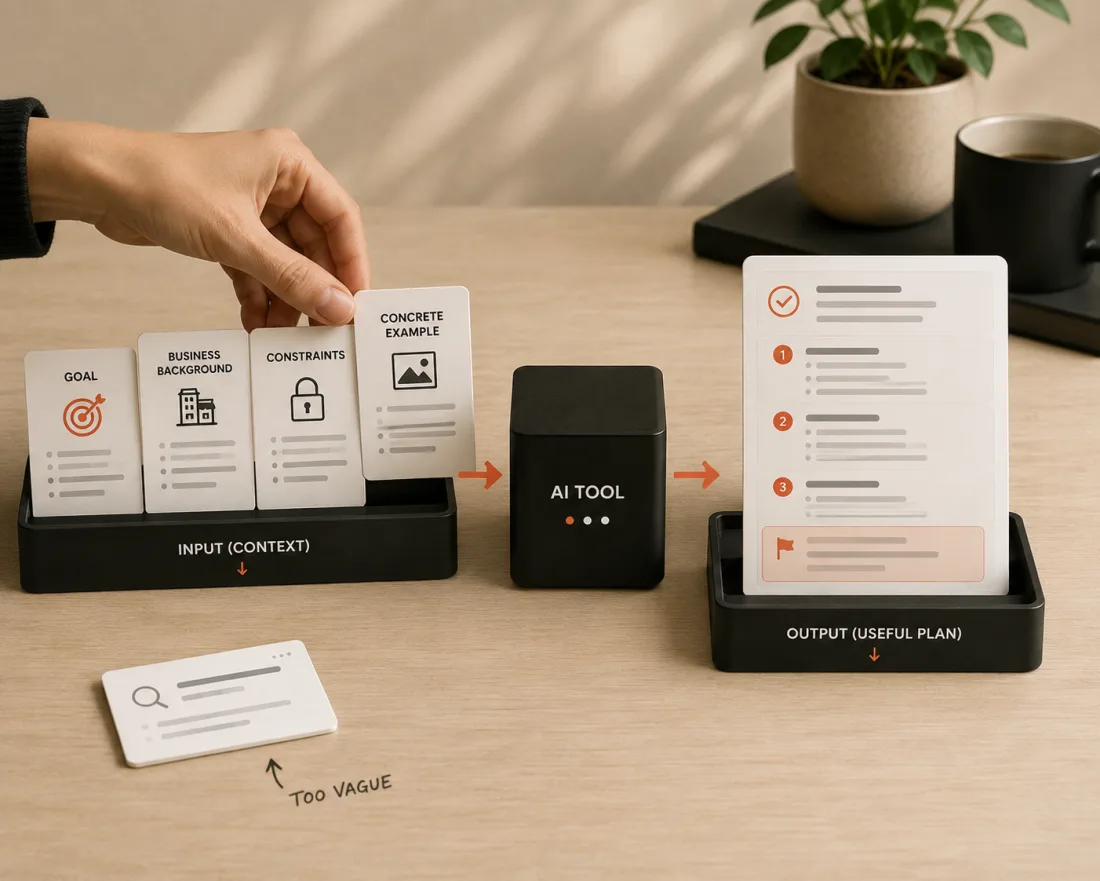
A simple way to think about it is this. Searching is asking a library where a book is. Working with AI is briefing a new assistant on their first morning. The library needs three words. The assistant needs to know what you are actually trying to do.
What a useful request contains
You do not need a prompt template. You need to say the things you already know and did not think to mention.
Four of them do most of the work.
Who you are, and who it is for. "I run a two-person dental clinic. This email goes to a patient who has not booked their check-up in eleven months."
What you actually want to happen. Not "write an email" but "get them to book without making them feel chased."
Anything the AI could not possibly know. Your prices, your policy, what happened on the last call, the fact that this particular client is sensitive about cost.
What good looks like. Short or detailed. Warm or formal. Two options or one. If you have an example of something that worked before, give it that.
Put those four into the request and the same tool produces something you can almost send. Nothing about the model changed. You just stopped making it guess.
Give it context, not instructions
This is the part that took me longest to understand.
Most advice about AI focuses on phrasing, as though there is a magic sentence. There is not. The gains come from information, not wording.
Think about the difference between these two.
> Make it sound more professional.
> This goes to a client who has already paid a deposit and is nervous about the timeline. I want them to feel like things are under control, without promising a date I cannot meet.
The first is an instruction. The second is a situation.
The second one works better every time, and it does not require you to know a single thing about how AI works.
Tell it what you do not want
People forget this half.
If you have ever read something and thought "this obviously came from AI," what you were reacting to was usually a set of default habits: opening with "in today's fast-paced world," using three adjectives where one would do, and ending on a tidy summary nobody asked for.
You can just say no to those.
> No introduction. Do not summarize at the end. Plain words. If you do not know something, leave a blank rather than inventing it.
That last one matters more than the rest combined. Left alone, AI would rather produce a confident sentence than an incomplete one. Telling it that a gap is an acceptable answer is how you stop it filling gaps with invention.
Work in passes, not in one shot
The single biggest habit change: stop expecting the first reply to be the finished thing.
Nobody briefs a new employee once, walks away, and expects perfect work. You give them a draft task, look at what comes back, and correct course.
Same thing here.
1. Ask for a rough version. 2. Say what is wrong with it, specifically. "Too long. The second paragraph is generic. Keep the third one, that part is right." 3. Ask for a revision that keeps what worked.
"Make it better" gets you a lateral move. "Cut the middle section and make the ending less formal" gets you a better draft.
The conversation is the tool. The first message is just the start of it.
A worked example
Here is the same task, done both ways.
The thin version:
> Write a proposal for a website project.
You will get a generic template with placeholder pricing and a section about "leveraging cutting-edge technology."
The version that works:
> I am a solo web developer. I am writing to a bakery owner who wants online ordering. We spoke on Tuesday and her main worry is that her current site is slow on phones and she loses orders because of it. > > Write a one-page proposal. Warm but not chatty, because she is not technical. Cover: what I would build, roughly how long, and what she needs to give me. My rate is a fixed project fee, and I have not decided the number yet, so leave that as a blank for me to fill. > > No introduction paragraph. Do not use the word "solution."
Same tool. Same five seconds of processing. Completely different result, because the second one contains the four things only you knew.
The honest limits
Three things worth knowing before you rely on this.
It will still be wrong sometimes. Better context reduces invented facts. It does not eliminate them. Anything checkable, check, and it is worth knowing when to trust it and when to verify.
It does not know your business unless you tell it. Each new conversation starts blank. If you find yourself explaining the same background every time, write it once and keep it somewhere you can paste from.
It is not good at knowing what matters. It can write the email. Deciding whether that client should be chased at all is still your job, and it always will be.
The one habit to take away
Before you press enter, read your request back and ask: could a competent stranger do this task from what I have written?
If they would have to come back and ask you three questions, the AI will not ask. It will guess, and the guess is what disappoints you.
Answer those three questions up front, and most of the frustration disappears.
That is the whole skill. It is not clever wording. It is just telling it the things you already know.