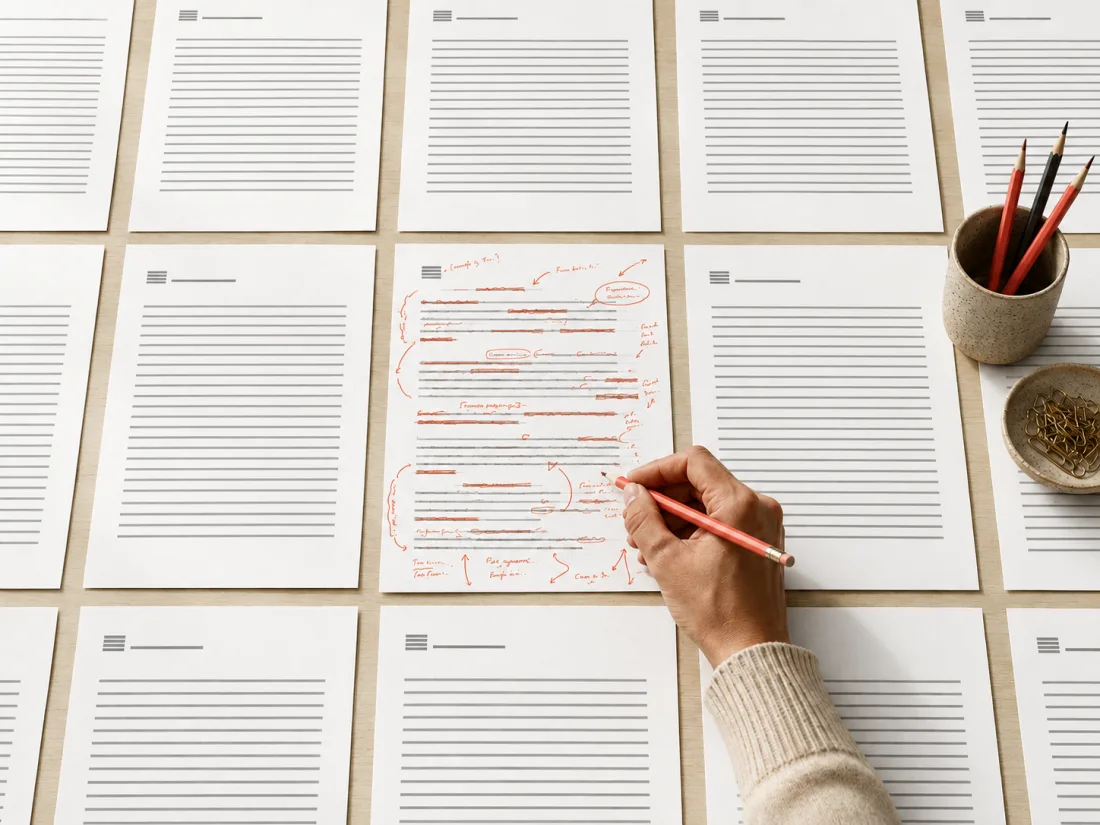
The tells
The warm-up paragraph. It opens by explaining that the topic is important. "In today's fast-paced business environment, communication is more critical than ever." Nobody has ever needed this sentence. Delete the first paragraph and the piece usually starts better.
Three adjectives where one would do. "A clear, concise, and compelling message." Real people pick one word and move on.
The tidy summary nobody asked for. It closes by restating what it just said. In a five-paragraph email this is absurd, and it happens constantly.
Perfectly even rhythm. Every sentence roughly the same length, every paragraph roughly the same size. Human writing is lumpy. A four-word sentence follows a long one. That unevenness is most of what makes text sound like a person.
Hedging on everything. "This can often be a useful approach in many cases." Real people commit. If you believe it, say it.
Vocabulary nobody uses out loud. Delve, leverage, robust, seamless, tapestry, landscape, realm. Not wrong words. Just words that show up far more in generated text than in speech.
The rule of three, forever. Three bullet points, three examples, three benefits. Reality is rarely three.
No specifics. This is the big one, and it survives every attempt at editing. Generated writing describes categories where a person would name a thing. "A client" instead of "a bakery owner in Pune." "Improved results" instead of "she stopped losing phone orders."
That last tell is the one to fix first, because fixing it fixes most of the others by force.
Why it happens
AI writes the most likely next thing. That is close to a definition of average. Average writing is exactly the writing that sounds like it came from nowhere in particular.
A simple way to think about it is this. Ask a hundred people to describe a good email and average their answers. You get something true, useful, and completely lifeless. That average is the default voice.
Your voice is a deviation from average. So the work is not to make AI write better. It is to push it away from the middle, using the only thing the middle does not have: your specifics.
What actually works
Give it real details before it writes. This is the same habit that makes any AI request work better. Not "write about our new service." Instead: what it is, who asked for it, what they said, what it costs, what went wrong the first time. Specifics in, specifics out.
Give it a sample of your writing. Two or three paragraphs you actually wrote, with an instruction to match the rhythm and vocabulary. This does more than any amount of describing your tone. "Friendly but professional" means nothing. A real example means everything.
Ban the tells explicitly. Paste this into any writing request:
> No introduction paragraph. Do not summarize at the end. One adjective, not three. Vary sentence length. No hedging. Do not use: delve, leverage, robust, seamless, landscape, realm. If you do not know a specific detail, leave a blank rather than writing something vague.
Write the first and last lines yourself. These carry the most voice and take the least time. Let it handle the middle.
Read it out loud. The single best test. Anywhere you stumble, or feel slightly embarrassed, is a line you would not have written. Cut it.
The method that works best
Stop asking it to write your thing. Ask it to help you write your thing.
1. You dump the raw material. Messy notes, half sentences, the actual facts. No structure needed. 2. It organizes that into a rough draft. Nothing invented, only your material rearranged. 3. You rewrite the opening and closing, cut the hedges, and add the one specific detail only you know. 4. It does a final pass for typos and repetition, with an instruction not to change the wording otherwise.
The voice stays yours because the substance was always yours. It handled the shape.
That last instruction matters. Given a free hand on a final pass, it will quietly smooth your good lines back toward the average.
When to just write it yourself
Some writing should never be drafted by anything but you.
Apologies. If someone can tell you outsourced your apology, the apology has made things worse.
Bad news. Layoffs, price rises, project failures. People forgive a clumsy sentence. They do not forgive being handled.
Anything about a person. Recommendations, thank-yous, condolences. The value is entirely that you sat down and did it.
Your actual opinion. If the point is that you think something, generated text will produce a balanced view of what people generally think, which is the opposite of what you wanted.
Everything else is fair game.
The test
Before you publish, ask one question.
Could anyone in my industry have written this?
If yes, it is not finished. Add the thing only you know: the number, the name, the mistake you made, the client who said the thing. One specific detail per piece is usually enough to make it unmistakably yours.
That detail is also the part readers remember. Which means the fix for sounding like AI and the fix for being worth reading turn out to be the same fix.