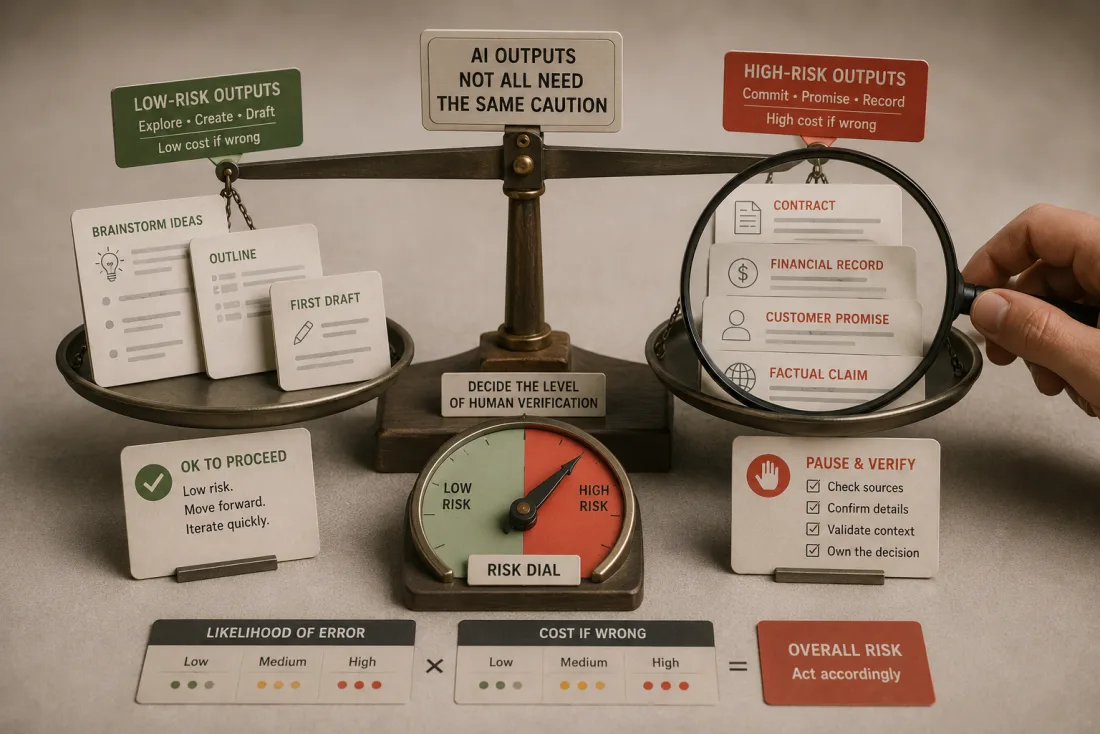
The rule
Trust it where the answer is already in front of you. Check it where the answer comes from somewhere you cannot see.
Ask it to summarize a document you pasted, and the material is right there. It is rearranging what you gave it. Errors are rare and obvious.
Ask it what the law says about deposits in your country, and the answer comes from somewhere you cannot inspect. It may be right. It may be a confident sentence assembled from things that sounded plausible together.
Same tool. Completely different reliability.
A simple way to think about it is this. Trust it like a very well-read colleague who has never once said "I do not know." Excellent at working with what is in front of them. Dangerous when asked for a fact from memory, because they will produce something rather than admit a gap.
Two questions before you rely on anything
1. How expensive is being wrong?
A wrong subject line costs nothing. A wrong tax figure, a wrong quoted price, a wrong medical claim, a wrong contract term. Those have real costs, sometimes ones you cannot undo.
2. Would I notice?
This is the more important one, and the one people skip.
If it wrote your client's name wrong, you would spot it instantly. If it wrote a plausible but wrong statistic about your industry, would you? If not, that is exactly where the danger sits.
High cost plus you would not notice is the only genuinely dangerous quadrant. That combination is where every AI horror story comes from.
Everything else is manageable.
Safe without checking
- Rewriting, shortening, or reformatting your own text
- Summarizing something you provided
- Brainstorming, where the whole point is that you pick
- Explaining a general concept you will not act on immediately
- Sorting and categorizing, where you see the result
- First drafts you are going to rewrite anyway
Always check
- Numbers of any kind
- Names, dates, and quotes
- Anything legal, medical, financial, or about safety
- Claims about what a company, tool, or law currently does
- Anything you are about to say publicly in your own name
- Anything about your own business it could not have known
The pattern: check anything you would have looked up before, and anything a person could be harmed by.
Why it invents things
Worth understanding, because it changes how you read the output.
AI produces the most likely next words. It is not consulting a database and reporting back. It is assembling something that reads like a correct answer.
Most of the time, the thing that reads most like a correct answer is a correct answer.
But when it does not know, nothing tells it to stop. There is no gap it can feel. It produces the shape of an answer, and the shape is just as fluent and confident as a true one.
This is why "it sounded sure" carries no information at all. Confidence is not a signal here, and unlearning that instinct is most of the skill.
Three fast ways to check
The instructions in how to talk to AI reduce invented answers, but they do not remove the need to check.
Ask for the source, then look at it. Not just whether it gives one. Actually open it. A source that does not exist, or does not say what was claimed, is the most common failure.
Ask it the same thing in a fresh conversation. If the answer changes meaningfully, it did not know. This takes twenty seconds and catches a lot.
Ask it to argue against itself. "What would make this answer wrong?" Genuine facts survive. Invented ones tend to collapse, because there was nothing underneath.
None of these takes more than a minute, and you only need them in the high-cost quadrant.
The instruction that helps most
Add this to any request where facts matter:
> If you are not sure about something, say so instead of guessing. Leave a blank rather than inventing a detail. It is better to give me an incomplete answer than a confident wrong one.
It does not make it perfect. It measurably reduces invented specifics, because you have explicitly told it that an incomplete answer is acceptable. By default it assumes the opposite.
Where the responsibility sits
One thing worth being clear about.
If you send a client a wrong number, it is your wrong number. Nobody outside your business cares which tool produced it, and "the AI said so" is not a thing you can say to someone who has been given bad information.
That is not an argument against using it. It is an argument for knowing which quadrant you are in.
Most of the work you will hand over is low-cost or immediately visible, and needs no ceremony at all.
The small remainder needs a minute of checking.
Knowing which is which is the entire skill, and it takes about a week of paying attention to develop.