What you are actually paying for
Not code. You are paying for decisions, integrations, and certainty. Scope drives the number more than technology does, and integrations with systems you do not control are usually the single largest multiplier — because you are buying someone else's constraints along with them.
The costs people forget are the ones after launch: hosting, maintenance, and the changes you will want once real people use it. A build price quoted without them is not a real price.
When custom is actually worth it
When the thing you need is genuinely specific to how you work, and an off-the-shelf tool would force you to change the business to fit it. That is the whole test.
It is worth being honest that the answer is often no — and that there is usually a rung between "use the standard tool" and "commission a custom build" that solves a surprising share of cases for a fraction of the cost. Most people skip straight past it.
The part after the code works
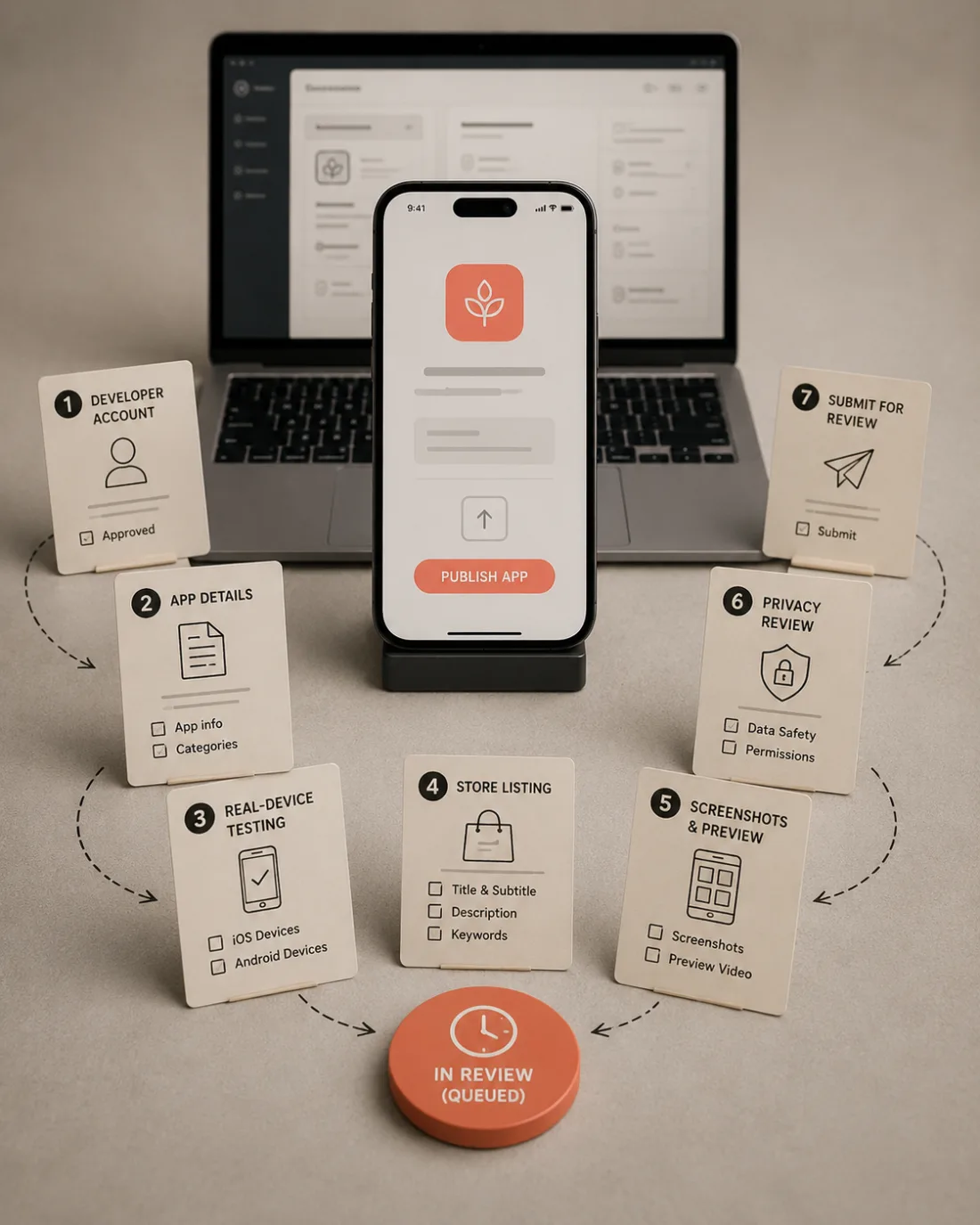
An app running on your machine is roughly halfway. What follows is seven distinct phases: the developer account queue, the app record, the build, the listing, screenshots, privacy and review notes, then submission.
None of it is hard. All of it takes longer than planned, and the account queue is the phase nobody can do on your behalf. First submissions are usually rejected for listing and metadata problems rather than anything wrong with the app.
One practical rule: submit before you announce. Review timing is not something you control, and a launch date promised against an unapproved build is a promise made on someone else's schedule.
The posts below cover the cost question, the custom-versus-standard decision, and the publishing process step by step.