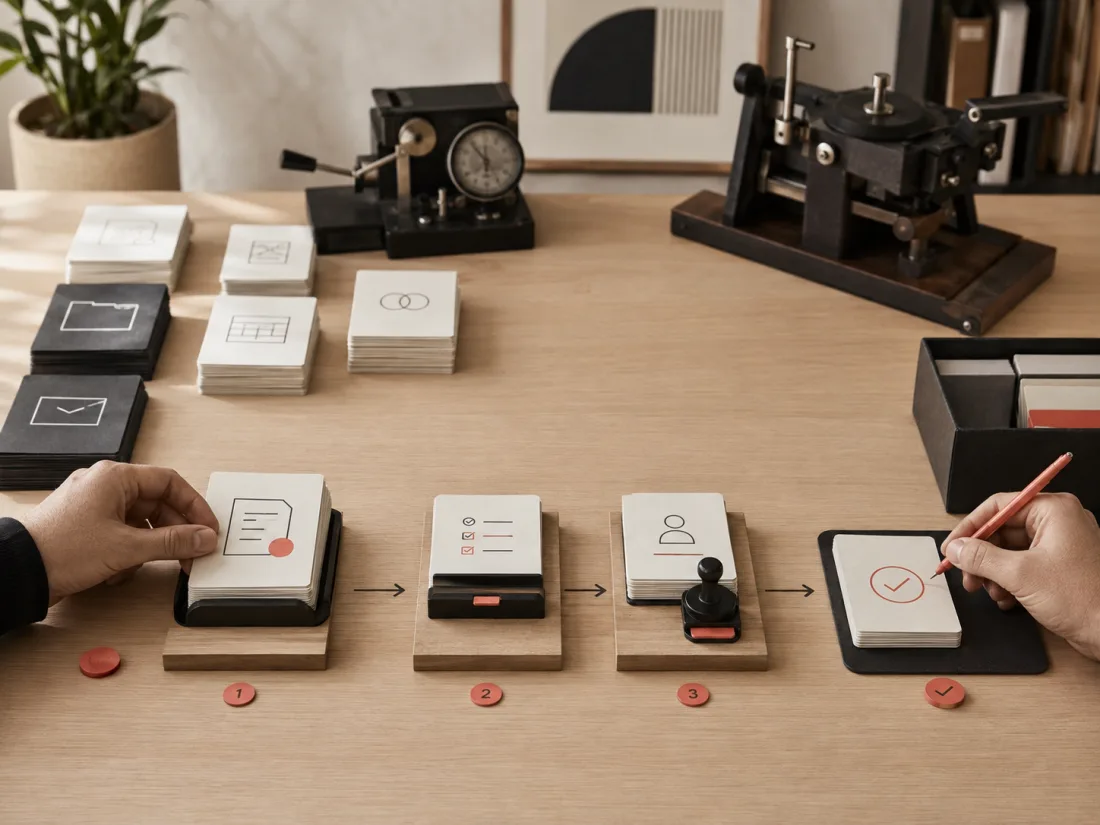
The right first task has four properties
It happens often. At least weekly. Something quarterly will never repay the setup, and you will forget how it works before it runs again.
It is boring. No judgment calls. If doing it well depends on knowing this client, it is not the one.
You can check it in under a minute. You need to be able to glance at the output and know immediately whether it is right. This matters more than people expect. Automation you cannot verify is a liability with better branding.
Being wrong once is survivable. Not invoices to clients. Not anything legal. Something where a bad output means you fix it and move on.
Score your candidates against those four. The winner is rarely the one you would have guessed.
The tasks that usually win
For most small businesses, the first automation is one of these.
Writing up calls. Recording exists, notes do not, everyone hates the gap. Frequent, boring, instantly checkable.
Sorting the inbox. Not replying. Just deciding what is a lead, what is urgent, and what can wait.
The reply you have written a hundred times. Availability, pricing questions, "where is my order," the same onboarding explanation.
Turning one update into several posts. One thing happened. It needs to be a post, a caption, and an email line.
Filing and extracting. Receipts into a sheet. Invoice details into a row. Documents into a deadline in your calendar.
Notice all five are transformations, not decisions. Something already exists and needs to become something else. That shape is why they work.
The step everybody skips
Here is where most attempts actually die, and it has nothing to do with technology.
You cannot automate a process you have never written down.
If the job lives in your head as a series of habits, you will not be able to describe it well enough to hand over. You will explain half of it, get a result that misses the other half, and decide the tool is not smart enough.
The tool was fine. The brief was half a brief.
So before automating anything, do this: the next time you perform the task, record yourself doing it and narrate what you are doing and why. Fifteen minutes. Then turn that into a written process.
You will discover two things. First, the task has steps you never consciously noticed. Second, some of those steps exist for no reason at all.
A simple way to think about it is this. Writing the process down is like tidying a room before you photograph it. The tidying is most of the work, and it is worth doing even if nobody ever takes the photo.
Plenty of people get to the end of that exercise, delete three steps, and no longer need to automate anything.
Start assisted, not automatic
There is a difference between AI doing a task and AI running it unsupervised.
Go through three stages, and do not skip ahead.
1. You do it with help. AI drafts, you review everything, you correct it. You are still learning what a good brief contains. 2. It does it, you approve. Output lands somewhere you check before it goes anywhere. Most small businesses should stop here permanently for anything customer-facing. 3. It runs by itself. Only for tasks where a mistake is cheap and visible.
Most disasters come from jumping to stage three because stage two felt slow. Stage two is not a transitional phase you have to escape. For a lot of work it is the correct final answer.
How to tell it worked
Pick your measure before you start, or you will argue with yourself later.
Two honest ones:
Time. How long did it take before, and after, including your review? Include the review. The honest numbers here are smaller than the headlines suggest. Automation that saves twenty minutes and adds fifteen minutes of checking saved five minutes.
Whether it still happens. Sometimes the win is not speed. It is that call notes now get written every time instead of when you remember. Consistency is worth more than minutes in most small businesses.
If neither improved after a month, stop. A failed automation you keep maintaining out of stubbornness is worse than never starting.
The order, if you want one
1. Pick the boring, frequent, checkable task. 2. Record yourself doing it once and write it down. 3. Delete the steps that turn out to be pointless. 4. Do it with AI five times, correcting as you go. 5. Move to draft-and-approve. 6. Only then consider a second task.
One task, done to the point where it genuinely runs, beats five half-finished experiments. The second one takes a fraction of the effort, because by then you have learned the thing that actually transfers: how to describe your own work clearly.
That skill is the real output of the exercise. The time saved is a side effect.