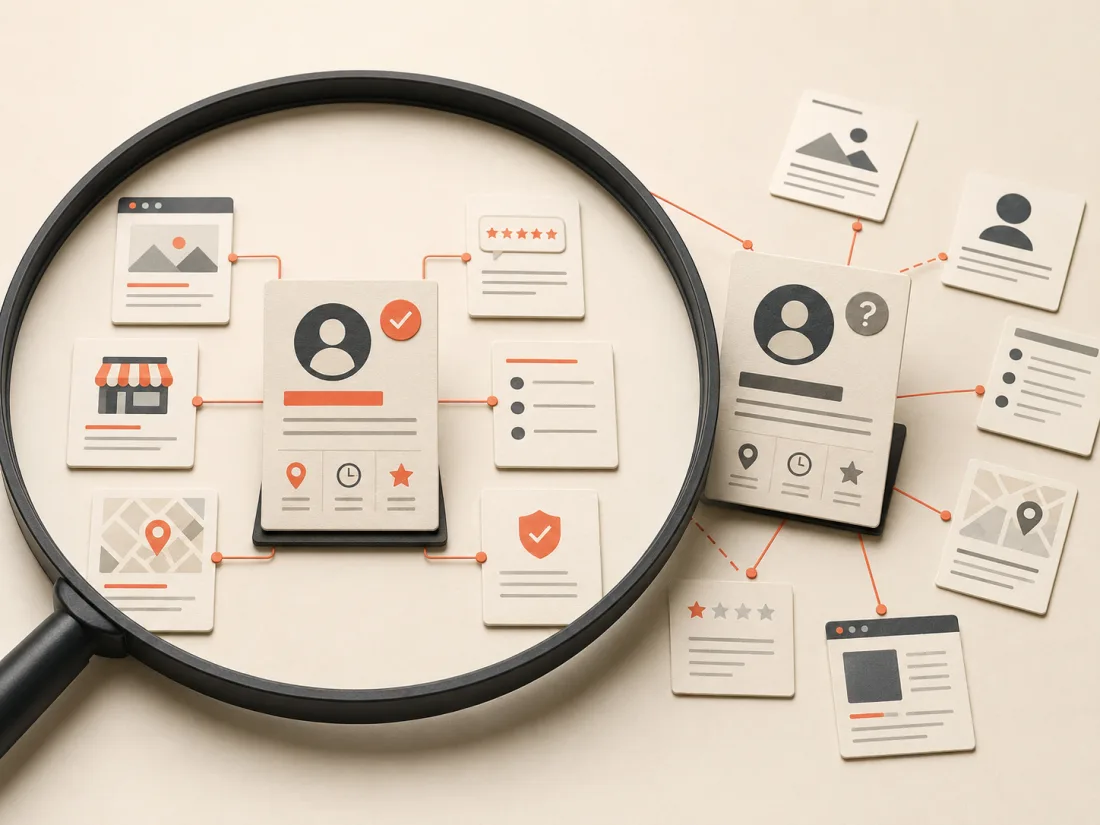
First, work out which one is yours
Before fixing anything, find out what is actually happening. Ten minutes.
Open ChatGPT, Perplexity, and Google's AI mode. Ask each one three things:
1. "What does [your exact business name] do?" 2. "Who would you recommend for [what you do] in [your area]?" 3. "[Your competitor's name] vs [your name], which is better for [type of customer]?"
The answers to those three tell you which cause you have.
- Question 1 comes back wrong or vague: cause 1 or 2.
- Question 1 is fine but you never appear in question 2: cause 3 or 4.
- You appear in question 2, but always behind them: cause 5.
Now the causes.
Cause 1: It cannot read you at all
The least glamorous and more common than anyone expects.
Some hosting setups and security services block AI crawlers by default. If GPTBot, ClaudeBot, PerplexityBot, or Bingbot are disallowed in your robots.txt, these tools cannot fetch your pages. You are not losing on quality. You are not in the competition.
The same applies if your key information lives inside images, or only appears after heavy scripting. If you cannot select the text with your cursor, assume it may not be read.
The fix: check your robots.txt. Fifteen minutes, free, and it is the first thing to rule out.
Cause 2: You are a blurry entity
Your homepage says one thing. Your about page says something slightly different. Your Google profile is two years old. Your directory listing has the old business name.
The tool now has four descriptions of you that do not quite match. Blurry sources do not get recommended, because recommending them is risky. Your competitor, whose description is identical in six places, is the safer thing to say.
This is the single most common cause I find, and it has nothing to do with the quality of your work.
The fix: write one description of your business, using the source-of-truth profile structure. Same name spelling, same one-line summary, same location wording. Put it everywhere you exist. Boring, unpaid, and more effective than anything else on this list.
Cause 3: You never answered the question being asked
People do not ask AI tools for a business. They ask for a solution to a problem.
"Who can help me stop losing patient bookings from my website?"
If your site talks about your process, your values, and your beautiful craft, but never plainly addresses that problem, there is nothing to match. Your competitor wrote a page called "Why clinics lose bookings" and got named.
The fix: write down the five questions your last ten enquiries actually asked. Answer each one plainly on a public page, with the answer in the first two sentences. Not behind a form. Not "contact us to learn more."
Cause 4: You gave it nothing safe to repeat
This is the subtle one, and it catches good businesses constantly.
These tools prefer to say things that are specific and checkable, because a vague claim exposes them if it is wrong.
"We deliver exceptional quality" cannot be repeated. There is nothing in it.
"Most clinic sites we build take two weeks and start at a fixed fee" can be repeated. It has a subject, a timeframe, and a shape.
Count the checkable facts on your site. Prices or ranges, timelines, quantities, specific outcomes, dates. If the count is near zero, you have given these tools nothing to work with, and they will quote the competitor who published a price.
The fix: put at least one checkable fact on every important page. A range is fine. "Projects typically run two to six weeks" is infinitely better than silence.
Cause 5: The internet corroborates them and not you
This is the one that takes longest to fix, and the one people skip.
AI answers lean on what the wider web says about a business, not only what the business says about itself. Your competitor appears in three directories, a local news piece, two podcasts, and a roundup post. You appear on your own website.
A business described in similar terms by several independent sources reads as more reliable than one making claims alone on its own domain.
Notice this is not about backlinks in the old SEO sense. A plain mention counts even without a link, because the value here is corroboration, not a passed signal.
The fix: get listed properly in the obvious directories for your industry. Say yes to the podcast. Write the guest post. Ask your happy clients for reviews on platforms that are publicly readable. Slow, and it compounds.
The one that is not on the list
Notice that "your competitor is better than you" is not one of the five.
It can be true. Usually it is not the reason. The businesses that get recommended by AI tools are the ones that are easiest to describe accurately, and that is a completely different skill from being good at the work.
Which is genuinely good news, because being easy to describe is something you can fix in a few weekends. Being better at the actual work takes years.
What to expect
Fixes take weeks to show up, not days. These systems re-crawl on their own schedule and their answers vary between sessions anyway.
So write down today's answers before you change anything. Then re-ask monthly, with identical wording. Without that record you will get a slightly different answer in a fortnight, because you always would, and have no idea whether you caused it.
And to be clear about something you may be offered: there is no submission process. No console, no placement program, nobody to pay for inclusion. Anyone selling you a shortcut into ChatGPT is selling air.
The only real lever is being the easiest business in your category to describe correctly.
Your competitor is not winning because they are better. They are winning because they are clearer.